Squeeze Casting: An Efficient Solution for Demanding Cast Components
The squeeze casting process offers significant potential for producing heavy-duty aluminum castings with minimized porosity and increased microstructural density. Particularly for geometrically complex components or for castings subjected to subsequent forming operations, this process provides a technological bridge between high pressure die casting and low pressure die casting.
In cooperation with the aluminum foundry Top Alulit, s.r.o., Czech Republic, a simulation-driven process development was conducted using a real series production part – a timing belt tensioner for combustion engines. The optimization was based on MAGMASOFT®, a tool firmly established at Top Alulit as an integral part of their structured process development for their R&D activities.
Squeeze Casting – Combining the Advantages of Both High and Low Pressure Die Casting
Squeeze casting is applied when conventional high pressure die casting processes are unable to reliably achieve the required mechanical properties. This hybrid casting process combines the low-turbulence, uniform mold filling and machine configuration of low pressure die casting with the short cycle times, dimensional accuracy of fine structures, and flexible pressure curve control typical of high pressure die casting. The vertical machine design, combined with a horizontal parting line, reduces defect rates and increases yield, while integration into automated production cells ensures both reproducibility and long-term stability of the process control.
A key advantage of this process is the directional solidification under pressure, which significantly reduces metallurgical defects such as gas porosity and shrinkage. This results in improved microstructural homogeneity and statistically reproducible mechanical properties – both essential prerequisites for quality assurance in series production. In addition, the process provides a structural-mechanically sound basis for subsequent forming processes. High process stability also contributes to a sustainable reduction of unit manufacturing costs.
Case Study: Optimization of a Timing Belt Tensioner Made of an Al-Si Alloy
As part of a development project, Top Alulit produced a timing belt tensioner made of a high-strength Al-Si casting alloy. The objective was to evaluate the feasibility of manufacturing the part by squeeze casting with respect to process efficiency, reproducibility, and material integrity – particularly in view of the subsequent cold forming operation.
The key challenge was to ensure sufficient ductility while simultaneously achieving high casting quality. Avoiding process-induced inhomogeneities – especially air entrapment in mechanically highly loaded functional areas – was essential, as they directly compromise the formability and operational reliability of the component.
Casting Process Simulation and Hot Spot Analysis
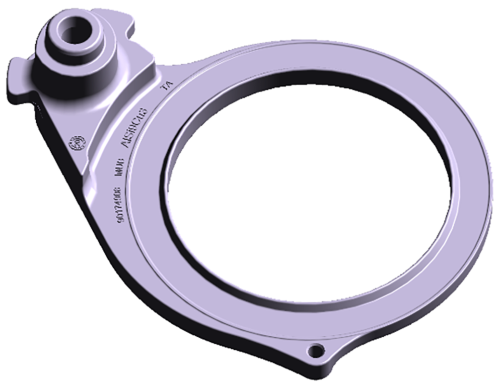
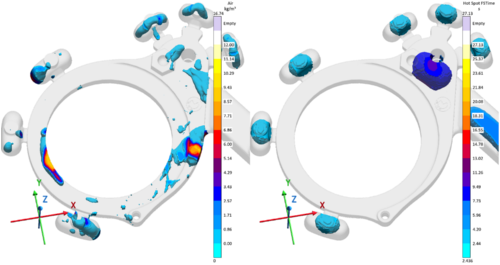
The starting point for the analysis was the existing part design (Fig. 1) with an initially defined die casting layout. Using real process parameters, a numerical process simulation with MAGMASOFT® was carried out. The results revealed potential shrinkage porosity and entrapped air in the central functional area of the part (Fig. 2, left) – a zone subjected to high stress during subsequent cold forming.
The analysis of the 'Hot Spot' result (Fig. 2, right) identified a hot spot in heavy sections, which are typically prone to porosity formation. The risk of insufficient feeding in these regions was considered manageable due to the intensification pressure. Validation tests confirmed that entrapped air caused irreversible cracking during cold forming.
An optimization of the casting system was therefore essential.
Systematic Optimization of Both Gating and Venting Systems
Based on the simulation results, the gating system was systematically redesigned to minimize turbulence-induced air entrapment. The focus was on optimizing the mold filling kinematics to achieve a more laminar flow regime.
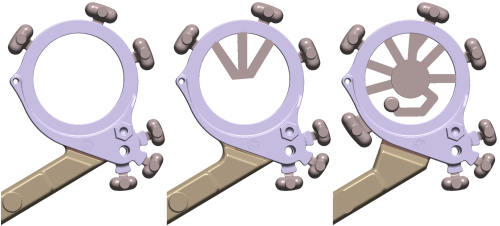
Due to geometric restrictions of the mold design, a conventional venting system could not be implemented. Instead, an innovative concept was developed: a radially oriented overflow layout, designed to direct entrapped air into peripheral regions without compromising the functional integrity of the part.
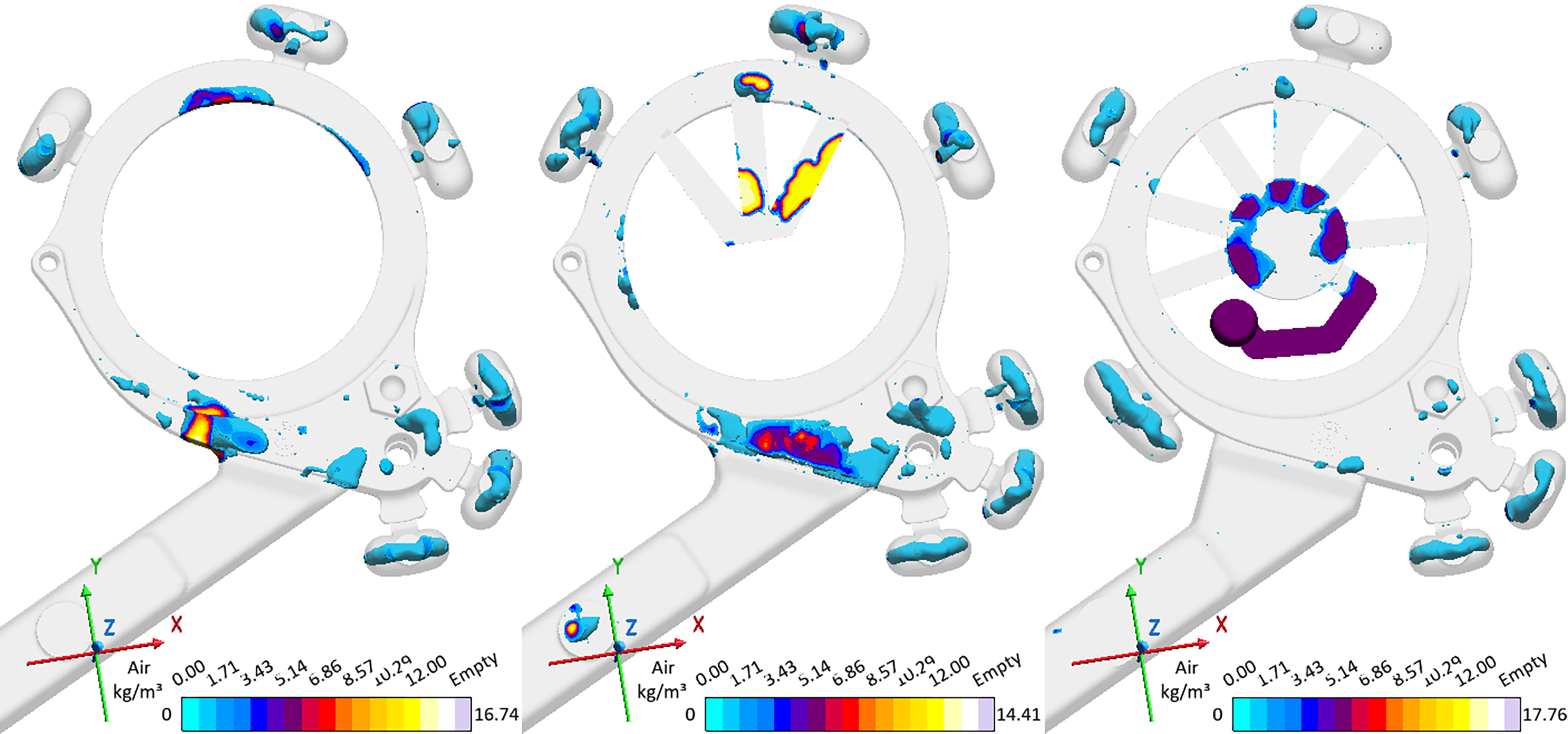
Several overflow design variants were developed and evaluated through simulation (Fig. 3). These configurations differed both in the number and arrangement of the "spokes" and in additional geometry modifications near the inner radius of the part. In parallel, the gating layout was adjusted to further reduce turbulence.
Design of Experiments (DoE) and Virtual Process Evaluation
To systematically evaluate the design variants, a virtual design of experiments (DoE) was implemented. Different combinations of gating and overflow configurations were varied and assessed based on quantitative criteria provided by MAGMASOFT®. The main focus was on reducing the specific air entrapment volume in predefined critical functional areas.
By using parallel coordinate diagrams, the most significant influencing factors could be isolated and tolerance limits for reliable process variants could be defined (Fig. 4).
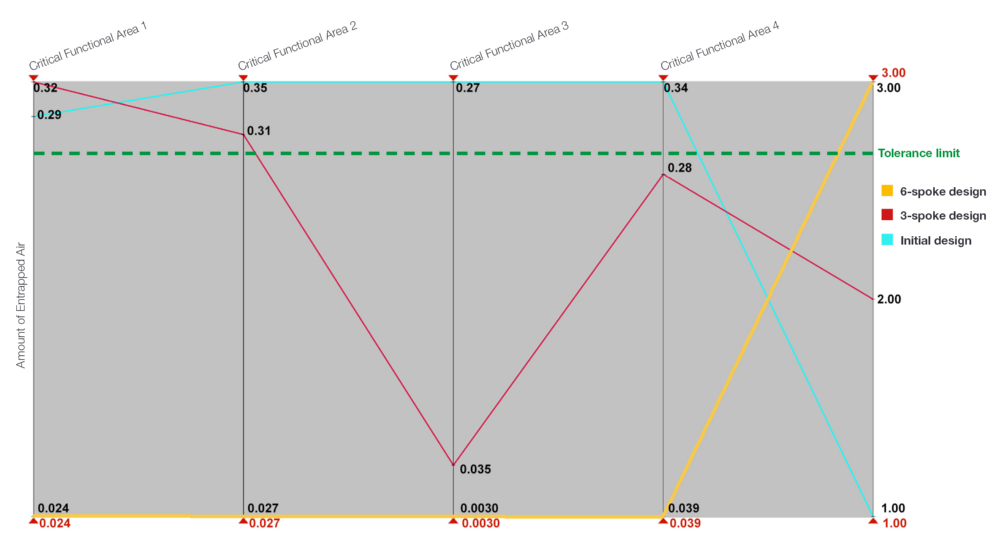
The analysis identified two significant design variants: a three-spoke overflow design and a more complex six-spoke variant with a central convergence point and an additional material extension. Both resulted in a substantial reduction in air entrapment-related defects. The six-spoke variant proved to be the most robust solution in the process evaluation and was adopted for series production (Fig. 5).
The implementation of the optimized casting system led to a significant reduction in crack sensitivity during cold forming. At the same time, the reproducibility of mechanical properties improved, and the scrap rate was sustainably reduced – without causing additional manufacturing costs.
The effectiveness of the optimization measures was confirmed through NDT methods and experimental forming
trials, which validated the improvements predicted by the simulation.
Conclusion and Economic Impact
This project demonstrates that the combination of squeeze casting and simulation-driven process development provides a reliable foundation for the production of demanding aluminum components. Using MAGMASOFT® allowed reliably identifying critical process windows, systematically optimizing the gating system, and sustainably increasing process stability.
For Top Alulit, this resulted not only in increased material and process maturity of the casting, but also in a direct, measurable benefit for the end customer thanks to higher operational reliability, improved part quality, and reduced scrap rates.
This case study thus highlights the innovation potential of simulation-driven methods as a strategic tool in modern foundry engineering, reinforcing their role in knowledge-based process control and industrial series production.
 Follow our official Wechat!